
Issue No. 037 · Boulder, CO·Default
How do cooling fans for cabinets support reliable operations?
The cooling fan directly enhances the reliability of equipment operation through precise temperature management. Research shows that when electronic components operate for a long time at a temperature 10 degrees Celsius higher than their rated working temperature, their failure probability will increase exponentially, with the maximum increase reaching 200%. For instance, a report from the Uptime Institute indicates that approximately 35% of unplanned downtime in data centers is related to overheating issues. By installing cooling fans, the hot spot temperature inside the cabinet can be reduced from a possible peak of 70 degrees Celsius to a safe range of 40 degrees Celsius, extending the mean time between failures (MTBF) of critical server components by more than 30%. A typical case is that after a large cloud computing service provider deployed a forced air cooling system for its high-density server cabinets, it reduced the hardware failure rate related to temperature by 25% and significantly improved the compliance of the Service Level Agreement (SLA) to over 99.99%.
In maintaining a stable operating environment, cooling fans indirectly ensure reliability by controlling humidity and particulate matter concentration. In addition to temperature, a relative humidity higher than 60% significantly increases the probability of short circuits in circuit boards, while a humidity lower than 40% is prone to the risk of electrostatic discharge (ESD), which can exceed 10,000 volts. High-quality cooling fans are usually integrated with air filters, which can ensure that the airflow speed is between 1.5 and 2.5 meters per second, and at the same time increase the blocking rate of dust particles larger than 5 microns to over 95%. For instance, in the smart factories of Industry 4.0 in Germany, the control cabinets of precision manufacturing equipment generally adopt such cooling fans with filtering functions, reducing the frequency of control system failures caused by environmental factors from five times a year to less than one, ensuring that the continuous operation efficiency of the production line is as high as 98%.
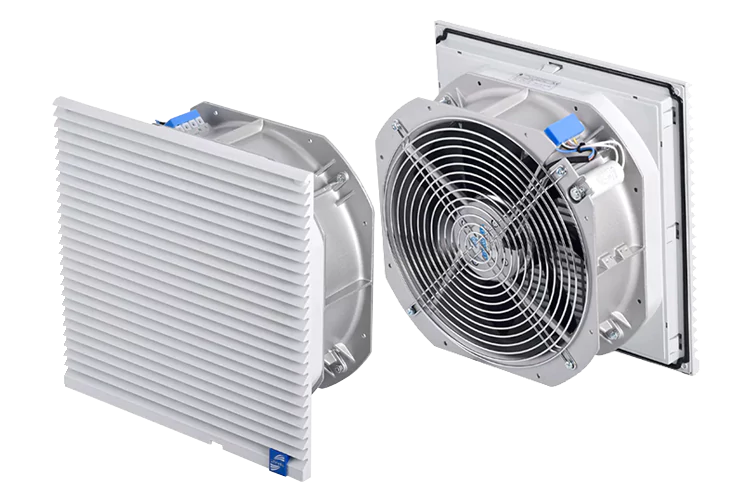 From the perspectives of energy efficiency and system stability, effective heat dissipation can reduce the performance frequency reduction of equipment for self-protection. In modern high-performance computing (HPC) clusters, Gpus and cpus initiate Thermal Throttling at high temperatures, causing computing speeds to drop by up to 50% and affecting task completion times. By optimizing the air flow organization within the cabinet to achieve an air flow rate of 50 cubic feet per minute (CFM), the cooling fans for cabinets can ensure that the chips operate above the reference frequency. Google's best practices in its data centers have confirmed that maintaining the cabinet intake temperature within a narrow fluctuation range of 27 degrees Celsius ±1 degree Celsius has reduced the overall computing task completion time deviation by 15% compared to an environment that allows a temperature fluctuation of up to 10 degrees Celsius, significantly enhancing the predictability and reliability of services.
Ultimately, the cooling fan's support for cabinets is reflected in the extension of the overall system life cycle and the optimization of the total cost of ownership (TCO). A five-year industry statistics shows that network devices that continuously operate within the recommended temperature range can have their service life extended from an average of five years to over seven years, with a reduced depreciation rate. For instance, in its network modernization project, British Telecom (BT) upgraded the active cooling solutions for approximately 100,000 outdoor communication cabinets, extending the equipment replacement cycle from four years to six years and saving about 18% in annual capital expenditure (CAPEX). This preventive maintenance strategy keeps the probability of unexpected failures below 1%, ensuring the reliable operation of critical infrastructure over its designed lifespan of more than 20 years.
From the perspectives of energy efficiency and system stability, effective heat dissipation can reduce the performance frequency reduction of equipment for self-protection. In modern high-performance computing (HPC) clusters, Gpus and cpus initiate Thermal Throttling at high temperatures, causing computing speeds to drop by up to 50% and affecting task completion times. By optimizing the air flow organization within the cabinet to achieve an air flow rate of 50 cubic feet per minute (CFM), the cooling fans for cabinets can ensure that the chips operate above the reference frequency. Google's best practices in its data centers have confirmed that maintaining the cabinet intake temperature within a narrow fluctuation range of 27 degrees Celsius ±1 degree Celsius has reduced the overall computing task completion time deviation by 15% compared to an environment that allows a temperature fluctuation of up to 10 degrees Celsius, significantly enhancing the predictability and reliability of services.
Ultimately, the cooling fan's support for cabinets is reflected in the extension of the overall system life cycle and the optimization of the total cost of ownership (TCO). A five-year industry statistics shows that network devices that continuously operate within the recommended temperature range can have their service life extended from an average of five years to over seven years, with a reduced depreciation rate. For instance, in its network modernization project, British Telecom (BT) upgraded the active cooling solutions for approximately 100,000 outdoor communication cabinets, extending the equipment replacement cycle from four years to six years and saving about 18% in annual capital expenditure (CAPEX). This preventive maintenance strategy keeps the probability of unexpected failures below 1%, ensuring the reliable operation of critical infrastructure over its designed lifespan of more than 20 years.
From the perspectives of energy efficiency and system stability, effective heat dissipation can reduce the performance frequency reduction of equipment for self-protection. In modern high-performance computing (HPC) clusters, Gpus and cpus initiate Thermal Throttling at high temperatures, causing computing speeds to drop by up to 50% and affecting task completion times. By optimizing the air flow organization within the cabinet to achieve an air flow rate of 50 cubic feet per minute (CFM), the cooling fans for cabinets can ensure that the chips operate above the reference frequency. Google's best practices in its data centers have confirmed that maintaining the cabinet intake temperature within a narrow fluctuation range of 27 degrees Celsius ±1 degree Celsius has reduced the overall computing task completion time deviation by 15% compared to an environment that allows a temperature fluctuation of up to 10 degrees Celsius, significantly enhancing the predictability and reliability of services.
Ultimately, the cooling fan's support for cabinets is reflected in the extension of the overall system life cycle and the optimization of the total cost of ownership (TCO). A five-year industry statistics shows that network devices that continuously operate within the recommended temperature range can have their service life extended from an average of five years to over seven years, with a reduced depreciation rate. For instance, in its network modernization project, British Telecom (BT) upgraded the active cooling solutions for approximately 100,000 outdoor communication cabinets, extending the equipment replacement cycle from four years to six years and saving about 18% in annual capital expenditure (CAPEX). This preventive maintenance strategy keeps the probability of unexpected failures below 1%, ensuring the reliable operation of critical infrastructure over its designed lifespan of more than 20 years.